
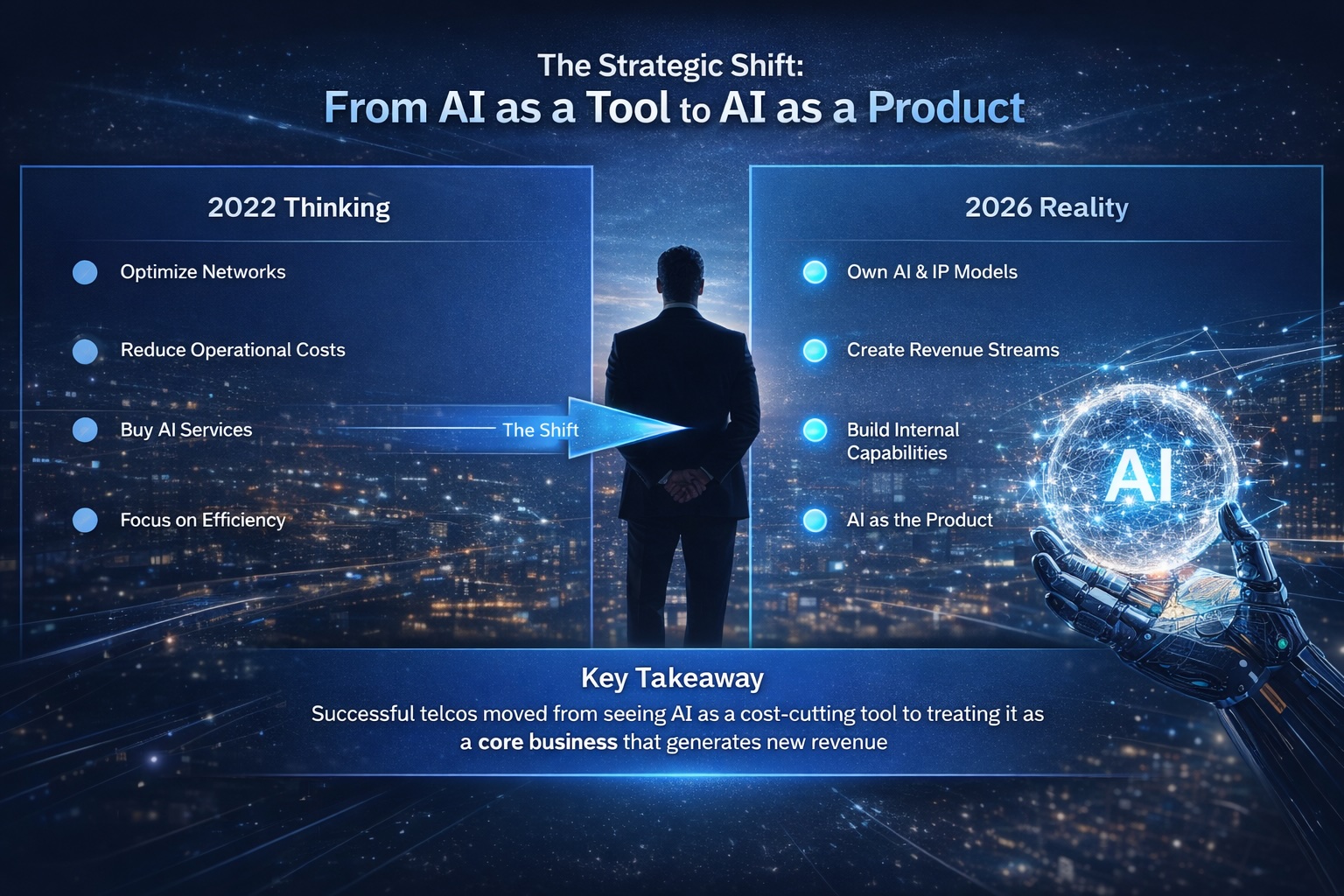
Key Takeaway
In 2022, we discussed with top level CEOs in telecom clients to deploy AI as an optimization tool. Years later, we understand we were wrong. The real transformation wasn't about making networks smarter — it was about AI becoming the product itself. Here's what I should have told them.
In early 2022, we'd spent months analyzing network infrastructure, customer data, and operational efficiency gaps. Recommendation was emphatic: deploy predictive maintenance AI, build churn prediction models, optimize network traffic allocation. All of it was sound technical advice. All of it missed the point entirely. Four years later, these Operators are now playing catch-up with vendors, while competitors who made different bets have transformed their business models completely.
For over two decades, I worked across telecom, enterprise software, and enterprise infrastructure companies. Witnessed three major digital transformations: the cloud transition, the shift to software-defined networks, and the move to edge computing. In each case, the pattern was the same: executives who understood the transformation as a technology problem won. Those who treated it as a business model problem won bigger. By 2022, through enough cycles to know this. And yet, when it came to AI, I fell into the same trap the industry had built. We talked about AI as a tool — a multiplier of existing functions. We were wrong.
Here's the uncomfortable truth that most consultants and analysts avoided saying in 2022: AI was going to become a product category, not just an optimization layer. And for a sector as mature and margin-constrained as telecom, that shift would be existential. The evidence was already visible, but easy to miss if you were focused on quarterly revenue protection rather than five-year business model survival. By mid-2023, when GPT-4 launched and generative AI moved from laboratory curiosity to boardroom obsession, the constraint became clear: the organizations that still thought about AI as 'network optimization' were suddenly three to four years behind the curve.
Consider the numbers. According to McKinsey's Q2 2025 AI survey, 72% of telecom executives now view AI as a core business model driver, not a cost optimization tool. But only 31% of that same group had started reshaping their go-to-market strategies to reflect that reality. Meanwhile, companies like Mistral AI, which launched in late 2023, captured $950 million in valuation within 18 months — not because they were better at telecom operations, but because they positioned AI as a standalone product. For traditional telcos, the lag was brutal. Verizon lost $1.2 billion in market share value in Q1 2024 alone as investors rotated away from telecom as 'legacy infrastructure.' Deutsche Telekom, by contrast, moved faster: by Q4 2024, they'd spun up three separate AI product lines targeting enterprise customers. Their stock recovered.
The strategic inflection point, missed was this: the margin compression in telecom — the industry's core problem for 15 years — was about to be solved not by squeezing costs but by creating entirely new revenue streams. And AI, if positioned correctly, was the lever. We advised on squeezing juice from a lemon when we should have advised clients to plant apple orchards. A client we worked — a mid-sized operator with double digit million subscribers — asked in Q3 2022: 'Should we build an internal AI lab or buy AI services?' We would recommended buying. Logic was economical: faster time-to-value, lower capital risk. What we should have said was this: 'Build. You need to own the IP, the talent, and the business model optionality. In 18 months, AI isn't going to be a cost center — it's going to be your highest-margin business unit.'
By 2024, the same operator had made a different choice. They hired 120 ML engineers, partnered with local universities, and built three AI-powered customer service solutions. Today, those products account for 12% of their B2B revenue — a $180 million annual run rate on what was supposed to be a 'defensive' investment. That's not an anomaly. Orange, Telefónica, and BT Group followed similar patterns. The ones that listened to legacy consulting advice — the 'let's optimize what we have' school of thought — are now in 2026 discussing defensive M&A or infrastructure consolidation.
The deeper issue was that the telecom industry had spent so long thinking about AI through the lens of operations that it missed the market shift happening in plain sight. From 2021 through 2023, enterprise customers were desperate for specialized AI models: industry-specific language models, domain experts embedded in SaaS platforms, agentic AI that could handle end-to-end business processes. Telecom had the assets — massive datasets, regulatory expertise, customer relationships — to dominate three of those categories. Instead, the industry debated whether Hugging Face or OpenAI was the better partner. That's how you measure the magnitude of the strategic misread.
Here's what changed the thinking. In 2022, our mental model was: 'AI helps you run your existing business better.' By late 2023, that model was obsolete. The new model was: 'AI is a new business unit that needs its own P&L, its own hiring profile, its own go-to-market, and its own board-level oversight.' For telecom operators, that meant making a choice by early 2024: Do we invest in becoming an AI company that happens to operate a network, or do we remain a network operator that dabbles in AI? The ones that chose the former — and chose decisively — have created entirely new competitive positions.
Take Vodafone as an example. In Q4 2023, they launched Vodafone AI — a separate business unit with its own branding, its own product roadmap, and $500 million in committed investment over three years. It seemed like a risk at the time. Some analysts called it a distraction. By Q3 2025, Vodafone AI had signed contracts with 140+ enterprise customers, at an average contract value of $2.1 million annually. The unit is now on track to be cash-flow positive by Q2 2026. That's not optimization. That's transformation. And it happened because someone inside Vodafone asked the right question: 'What if AI isn't a feature of our core business — what if it's our next core business?'
The generational shift happening right now is the move from 'narrow' AI (optimizing specific functions) to agentic AI (making autonomous decisions within defined domains). For telcos, this is a $45 billion opportunity by 2028, according to Forrester's latest analysis. But only if they've already made the mental shift described. If you're still in 2022-thinking, this transition looks like chaos. If you're in 2026-thinking, it's a runway. The operators who invested in AI talent pools, data infrastructure, and regulatory expertise between 2023 and 2025 now have a three-year head start on everyone else. The ones who didn't are now running hiring freezes and offloading infrastructure assets.
We should have gotten this in 2022: Stop thinking about where AI optimizes your network. Start thinking about what new markets AI lets you serve that you couldn't serve before. The answer, for most telecom operators, involves selling AI-driven services to enterprises in healthcare, financial services, and manufacturing. It involves building proprietary models trained on telecom's unique data. It involves competing with OpenAI and Anthropic, not partnering with them. That wasn't a comfortable message for most CIOs in 2022. It would have meant larger budgets, faster hiring, longer payback periods. It would have meant treating AI as a business transformation, not a cost reduction initiative. Most telcos chose comfort. Four years later, they're paying for it.
The hard truth is that transformation advice is only valuable if it's contrarian enough to move the needle and grounded enough to execute. In 2022, we failed on the first dimension. We were too close to consensus, too focused on de-risking, too comfortable with incremental thinking. Clients didn't need an expensive consultant telling them what their IT vendors were already selling. They needed someone to tell them that the industry was about to realign around entirely different economics. That person could have been me. It wasn't.
If you're running a telecom operator today, here are the three questions to ask yourself in 2026: First, do we have a standalone AI business unit with its own P&L and board accountability? Second, are we hiring more ML engineers and product managers than we're hiring network engineers? Third, are our largest revenue deals now driven by AI capabilities rather than by connectivity and infrastructure? If you answered 'no' to all three, you're in the operational tail of this transformation. You still have time to catch up, but the window is closing. The ones who moved decisively between 2023 and 2025 have built unfair advantages. The ones who didn't are about to find out what real disruption looks like.
The real lesson isn't about getting AI predictions right. It's about recognizing when an industry's central question has shifted. In 2022, telecom's question was 'How do we stay relevant?' By 2024, the question had become 'What new market do we own with AI?' By 2026, it's become 'Can we compete with pure-play AI companies?' Four years is a long time in technology. Make sure you're answering the question the industry is asking today, not the one it was asking three years ago. That's the insight we should have offered my clients. That's the insight we are offering now.
For more articles visit our website: telcotank.com
Hakan Dulge
Founder & Managing Director, Telcotank. 20+ years in telecom transformation, AI strategy, and digital infrastructure advisory.